


We look at the habitats so unique, rare, or long-lived that they cannot be included in a development area.
Some habitats or features are incredibly difficult, or even impossible, to restore or recreate once negatively impacted within the lifetime of the development. This is recognised by the Biodiversity Gain Requirements (Irreplaceable Habitat) Regulations 2024, naming eight habitat types considered irreplaceable. In this article, we discuss these habitats and the implications for your project if they are present in your plans.
Recap – What is Biodiversity Net Gain?
Biodiversity Net Gain (BNG) is a planning requirement that became mandatory in England in 2024. Developers must increase the biodiversity of both small and major development sites by a minimum of 10% compared to pre-development levels. Biodiversity is measured in standardised units, calculated using the statutory biodiversity metric. The figure is influenced by factors such as habitat type, condition, and size.
Habitat enhancement and creation should then be carried out on-site, where possible, to account for biodiversity units lost to the development, as well as increase overall units by a minimum of 10%. Where this is not possible, the developer can generate or sponsor biodiversity gain on another site (‘off-site’) which requires greater effort. As a last resort, statutory biodiversity credits can be purchased from the government. In order of decreasing preference, these options constitute the biodiversity gain hierarchy.
Some habitats are irreplaceable
However, some habitats are technically very difficult to recreate once destroyed. This may be because of their age, rarity, species assemblages, or the time taken for them to form.
The Biodiversity Gain Requirements (Irreplaceable Habitat) Regulations 2024 specify which habitats are deemed irreplaceable under BNG. Where these habitats may be impacted, a project cannot claim project-wide achievement of BNG and planning permission for development will only be granted in exceptional circumstances.
If it is given, a bespoke compensation strategy will need to be agreed with the authority.
Where there are no losses or deterioration of irreplaceable habitat, enhancement may contribute towards achieving BNG.
Which habitats are irreplaceable?
According to the Biodiversity Gain Requirements (Irreplaceable Habitat) Regulations 2024, the following are examples of irreplaceable habitats:
- Blanket bog
- Lowland fens
- Limestone pavements
- Coastal sand dunes
- Ancient woodland
- Ancient and veteran trees
- Spartina saltmarsh swards
- Mediterranean saltmarsh scrub
Irreplaceable habitats in more detail
Blanket bog
Blanket bog consists of rain-fed peat and the characteristic vegetation that grows on it – particularly Sphagnum mosses. Peat forms as dead plant material accumulates but doesn’t fully decompose due to waterlogged, oxygen-poor conditions. It typically takes a whole year to form just 1mm of peat. This means that one metre has developed over 1,000 years, with peat deeper than five metres not unusual in the UK. Blanket bogs are found throughout Britain, although they are most widespread in the wetter west and north. They’re home to a range of terrestrial and aquatic invertebrates and vertebrates, such as the red-throated diver (Gavia stellata) and Eurasian golden plover (Pluvialis apricaria). In the context of climate change, bogs are regarded as important carbon stores, as the carbon in the dead plant material that forms the peat is locked away.
Read the full habitat description for blanket bog on the Joint Nature Conservation Committee website.
Lowland fens
Fens are peatlands in which the peat is fed by surface water, groundwater, and rainfall. They receive more nutrients and can support a more diverse collection of plants and animals than bogs, with the Joint Nature Conservation Committee (JNCC) writing that fens can contain a third of our native plant species, over half the UK’s species of dragonflies, several thousand other insect species, as well as being an important habitat for aquatic beetles. Lowland fens are found in shallow valleys, at lake edges, and on floodplains, where drainage is poor and waterlogging creates conditions for peat formation. Often, lowland areas have been farmed intensively, and so fens are often small, fragmented, and isolated.
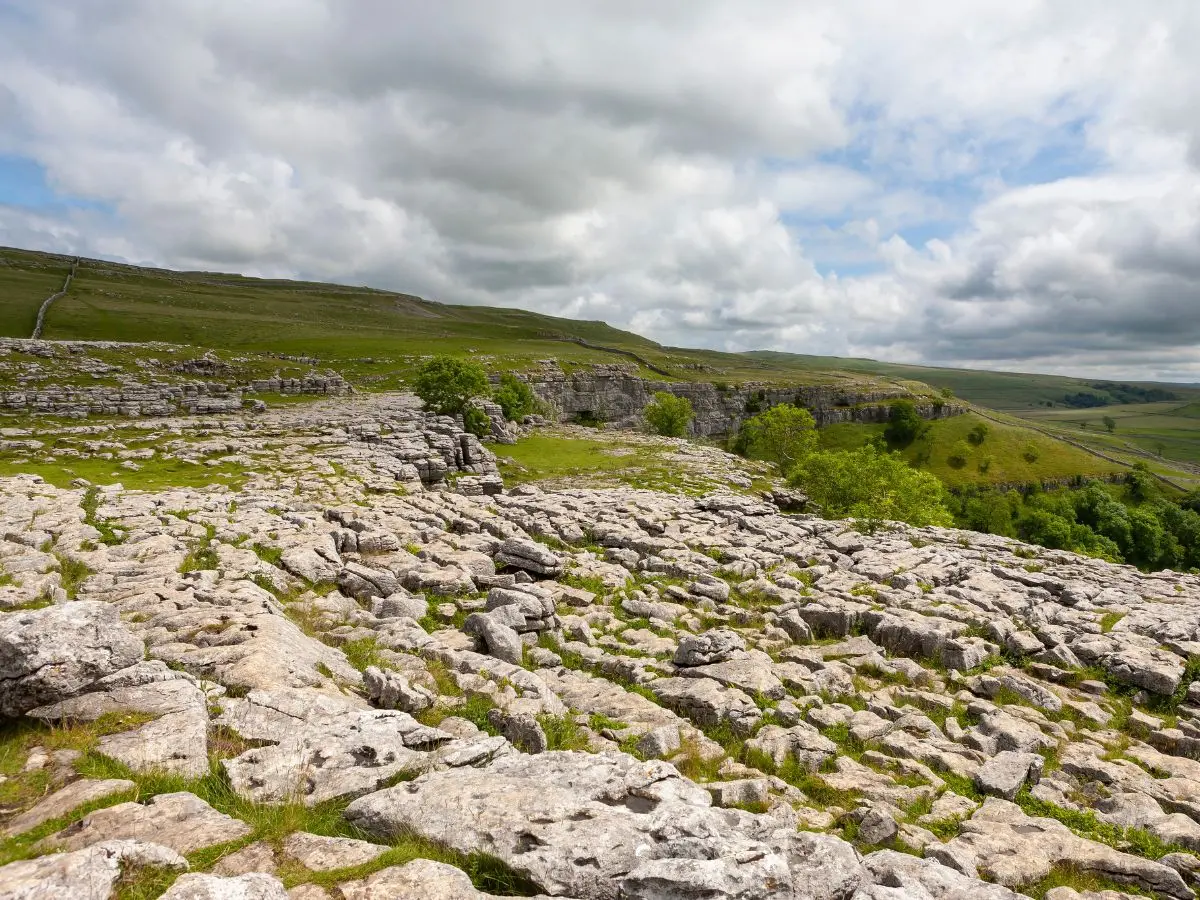
Limestone pavements
Limestone pavements are scarce, geologically important habitats that cannot be replaced. They were created during the ice age when moving glaciers scraped away soil and weak rock layers to expose embedded limestone. The permeability of limestone and the weak acidity of rainwater have led to the development of cracks in the rock, eventually creating isolated slabs of limestone – hence the term pavement. Limestone pavements are widely scattered throughout the UK, but their total area is less than 3,000 hectares. They are also ecologically important and can support unusual combinations of plants, such as woodland species, in the sheltered crevices and alpines on the rock surfaces, although the exact community depends on altitude, location, and limestone type. In the absence of grazing animals, scrub may develop, with importance for epiphytes (lichens, mosses, liverworts, and ferns).
Coastal sand dunes
Coastal sand dunes are formed when dry sand is blown landwards from the beach and deposited above the high-water mark. Plant assemblages depend on the age and stability of the dunes, as well as local conditions. New and/or shifting dunes host few plant species, the most characteristic being marram grass (Ammophila arenaria). Fixed dunes are typically covered in grasses (“closed swards”). Accumulation of organic matter and leaching of alkaline calcium carbonate can cause dunes to acidify, allowing for the development of dune heaths dominated by heather (Calluna vulgaris). Damp hollows between dune ridges also have characteristic vegetation, such as creeping willow (Salix repens ssp. argentea). Amongst dune grassland, dunes can also support colourful flowering plants such as orchids. Coastal dune systems are rich in invertebrates, too, including butterflies, moths and burrowing bees and wasps.
Ancient woodland
In the Biodiversity Gain Requirements (Irreplaceable Habitat) Regulations, ancient woodland is defined as an area of woodland that has been continuously wooded since 1600. Our ecologists can help you determine this. However, as an overview, the Woodland Trust recommend checking the ancient woodland inventory (AWI) and historical maps – which may be available online or in archives, or looking for “indicator plants” and/or historical manmade features such as medieval woodland boundaries (consisting of raised banks and ditches) or evidence of historical coppicing or pollarding. Ancient woodland is not necessarily unchanged, however, and the description includes ancient semi-natural woodlands, plantations on ancient woodland sites, ancient wood pasture and parkland, and infilled ancient wood pasture and parkland.
Ancient and veteran trees
Irreplaceable ancient or veteran tree habitat may constitute an individual tree or a collection of trees in any environment. Ancient trees have passed beyond maturity into an ancient life stage or are very old in comparison to other trees of the same species. Typically, ancient trees have a reduced (“retrenched”) crown and a wide trunk, often with signs of hollowing, decay, and deadwood. However, it depends on the species, growing conditions, and location. Veteran trees are mature trees that have characteristics of ancient trees, but are not developmentally or chronologically ancient. Like ancient trees, they are important for biodiversity, often hosting rare or specialist fungi, lichens and invertebrates. Although in the final stage of their life, it is important to realise that ancient trees can live for many more years. Indeed, ancient and veteran trees which have died are still regarded as irreplaceable because of their continued ecological value.
Ancient and veteran trees are the most commonly encountered irreplaceable habitat on development sites, and can occur in a wide range of settings, including parkland, hedgerows, and woodland.
Spartina saltmarsh swards
There are several species of Spartina in the UK, commonly known as cordgrass. Two – the UK’s native species and a North American, inadvertently-introduced one – are limited in distribution. The third, a fertile hybrid of the other two, is widespread, having both spread and been planted along lower shores that are regularly inundated with saltwater. Here, the Spartina traps sediment and aids in the formation of new saltmarsh areas. In the south, Spartina swards have suffered losses, whilst in the north and west, the plant is more problematic, often encroaching onto amenity beaches, colonising mudflats that are important bird-feeding areas, or threatening the floristic diversity of nearby saltmarsh. As such, Spartina saltmarsh swards are an interesting case: they are irreplaceable under the BNG regulations and protected in some areas yet would be considered for control in others.
Mediterranean saltmarsh scrub
This habitat is found on the uppermost levels of saltmarshes in the south and south-east of England, where the marsh transitions to sand dunes or shingle. The scrubby vegetation resembles that found on the Mediterranean coast, predominantly made up of seablite (Suaeda vera), sea purslane (Atriplex portulacoides), and occasionally perennial glasswort (Sarcocornia perennis). These plants are all halophilous, meaning that they are tolerant of highly saline (salty) environments. Their roots help to stabilise the soil and thick vegetation reduces the energy of waves, helping to prevent erosion. The scrub hosts a number of birds, including waders, geese, and ducks. Holkham Beach and Nature Reserve write that shrubby seablite is often “the first shelter for weather-blown migrant birds arriving on the coast”.
If you might be working with an irreplaceable habitat
It is important to identify irreplaceable habitats early in the design process so that development proposals can be designed in such a way as to avoid impacting these habitats. A Cura Terrae ecologist will confirm whether your site contains irreplaceable habitat. Negative impacts, including loss or degradation, to irreplaceable habitats should be avoided in line with relevant legislation and planning policy, except in exceptional circumstances.
If irreplaceable habitat is present on a site, it must be recorded in the statutory biodiversity metric tool, but it is excluded from calculation of biodiversity units. Where development affecting irreplaceable habitats is permitted by the local planning authority in exceptional circumstances, a bespoke compensation strategy will need to be developed and agreed to address any loss or deterioration.
Our ecologists will be able to advise and support you through this process.
Whether your site contains irreplaceable habitat or not, get in touch with our experts for comprehensive support with BNG.